I love poetry, just not in the station.- the Station Inspector
;
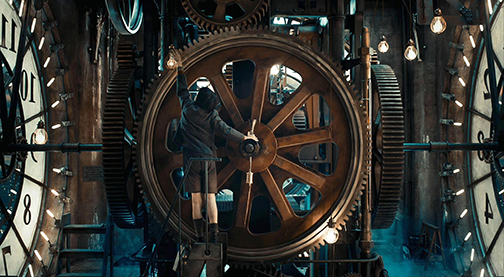
"60 seconds to a minute, 60 minutes to an hour. Time is everything", his new guardian, the drunkard Uncle Claude, tells twelve year old Hugo as they stand beside the grave of Hugo's father. Time is at the heart of Scorsese's Hugo. We first see Hugo behind the face of time, as he watches the goings-on in Paris's Gare Montparnasse through a removed numeral in the giant clock above the station's entrance.
I've read many reactions to Martin Scorsese's film Hugo. That it's about film preservation. That it's very pretty, end of story. That it's boring.
How we react to a work of art is always subjective, but as I've written before, I find Hugo to be an astonishing film, far richer and far more complex than the press coverage would indicate. To me, Hugo is an incredible meditation, asking more questions than it answers, on the relationship between time and art, imagination and the everyday, and the manufactures of man and how they redefine and reshape our sense of what it is to be human.
As of this week, it's still in theaters like the AMC River East, ICON off Roosevelt and a few others, but it will probably disappear after the Academy Awards and its release on video this Tuesday. I'd urge you to catch Hugo as should be seen - on the big screen - and if you're still interesting, read some my thoughts about the film here.
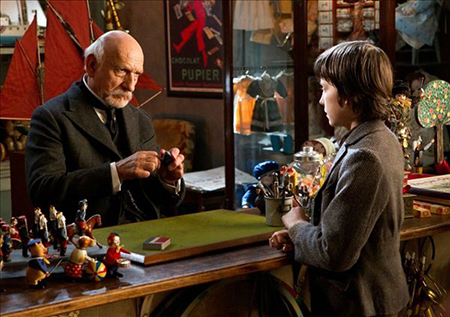
Railroad stations - like airports - are best known as places of anonymity, but out of the cattle-like stream of commuters, Hugo (Asa Butterfield) observes a selected family of the station's permanent residents: the stern but kindly bookseller played
by Christopher Lee, cafe proprietress Frances de la Tour and her
would-be suitor news-seller Richard Griffiths, flower stall operator
Emily Mortimer, and the man who admires her from afar, the menacing
Station Inspector played by Sascha Baron Cohen, who papers his office
walls with mug shots of all the children he's captured in the station and
sent off to the orphanage.
And finally, the old man sitting silently at the toy booth in a side corridor, Ben Kingsley in a deeply felt performance. As he looks up from his isolation - we never see him sell a single thing over the entire course of the film - in the center of his eye flashes the reflection of the rounded clock face from which Hugo is watching him. Time is everything.
Time is Hugo's job. He lives behind the walls of the great station, in a forgotten apartment and steampunkt maze of passageways, ladders, and a corkscrew chute straight out of Lady from Shanghai.
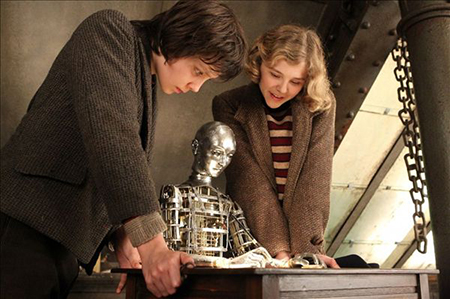
In flashback, we see a scrubbed-clean Hugo living a modest middle class life with his widowed clockmaker father, Jude Law, who one day brings home an incredible automaton, a mechanical figure shaped in human form, such as the "Draughtsman-Writer"
built by Henri Mailardet in 1800, which in the 19th century were a
mainstay of many of the best magician's acts. The special trick of the
automaton in Hugo, with its metallic, humanoid head reminiscent of the
robot in Fritz Lang's Metropolis, is the ability to write, but
its incredibly complex internal clockworks is in shambles.
Hugo's
father promises that together they can fix it, solve it. He contemplates a heart-shaped keyhole at the base of the automaton's neck. "Another complication . . . another mystery," says his father. "That makes you happy," observes Hugo.
Hugo is polishing the automaton's metal when the door bursts open to reveal his shambling Uncle Claude played by Ray Winstone. "There's been a fire. Your father's dead," he announces unceremoniously, sweeping Hugo away so quickly that the only thing he takes with him is the automaton, the last link to his father.
Claude introduces Hugo to his new home, behind the walls of the great station, the raw, brutal, throbbing mechanics that run the polished public spaces. Claude will train Hugo to help him to do his job, winding the station's many clocks. Soon Claude disappears, and that job becomes Hugo's alone, even as Hugo is now completely alone. He steals food from the cafe, and lives vicariously by observing his station "family", an orphan flaneur.
What winds Hugo, beyond basic survival, is his obsession to repair the automaton, using parts he's been stealing from the old man's toy booth. At the film's start, the old man finally catches him, confiscating the springs and coils in Hugo's pockets, and a small notebook. As the old man opens it, his face registers astonishment, then incomprehension, then pain. It contains Hugo's father's detailed sketches of the automaton and its intricate workings.
As the old man closes the booth at the end of the day, Hugo returns to demand the notebook. "I am going home to burn your notebook," he declares and Hugo, coatless in the cold, follows the old man home, through the shadow of death.
The path to the old man's apartment is through a graveyard, past a chilling sentinel of massive, hooded statues. He lives with his devoted wife, with whom he cares for their young stepdaughter. His is a life
of unexpectant waiting - for a customer, for the workday to end and be
able to return home, for death to come without further torment. The
forgotten work that gave his life meaning has been reduced to the
contents of a small valise on a hidden shelf in a tall bedroom armoire. When the notebook is returned to Hugo by the old man, it is a smoldering pack of ashes.
As the film progresses, Hugo joins forces with the old man's niece, Isabelle (Chloë Grace Mortez), who experiences life through the alternative world of literature. "You don't like books?", she asks Hugo incredulously. Hugo likes books, but he loves the movies, something the old man has forbidden Isabelle.
Hugo sneeks Isabelle into a cinema to see her first film, Harold Lloyd's Safety Last, and it is at this point Scorsese take's Hugo to a higher level. We've all seen Lloyd clinging desperately to the hands of that clock ("time is everything"), but to see it on a big screen, where the background is no longer a blur, but a super-realistic view of downtown Los Angeles in the 1920's, down to being able to read the signs in the windows and identify people in the street far below, gives the scene a kick it doesn't have confined to a small screen. We share Hugo and Isabelle's delight of discovery.
Together, they repair the automaton. It does not write, but draws, and what it draws is the scene of a rocket ship flying into the eye of man in the moon from the great 1902 silent, Le voyage dans la lune, which Hugo had previously described to Isabelle as a film he saw with his father. When the automaton signs the drawing the name of the film's creator, Georges Méliès, Isabelle is stunned. That is the full name of her guardian, the old man she knows as Papa George.
Another complication, another mystery.
Hugo and Isabelle's quest now takes them back to the bookstore, an amazing collection of books spilling over shells and piling up on the floor in stacks like stalagmites. From his high, Zeus-like perch, bookseller Christopher Lee directs to the exact section of shelf in the Film Academy Library (which, in truth, seems a little large for all the books written on film through 1931 - it's actually the Bibliothèque Sainte-Geneviève). As the pair read through a book on the history of cinema, Scorsese pulls back the curtains - literally - on a montage of early film.
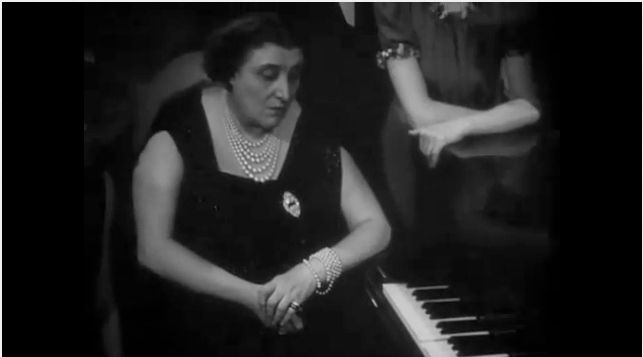
Set to same music of Saint Saens Danse Macabre used by Jean Renoi in Rules of the Game, in a scene where Odette Talazac watches, as in a trance, the keys of a player piano rise and fall untouched, we see a panicked audience rearing back from a train arriving in a station, Charlie Chaplin, 1896's a Kiss, the gunfighter shooting directly into towards the viewer, William S. Hart, the spectacular Babylon set from Intolerance, and finally, the rocket ship and the man-in-the-moon.
It's a spectacular sequence that packs an emotional wallop, and it's the introduction to the back end of Hugo, which we will discuss in the final installment of this piece.
 Observations and Images on Architecture, Culture and More, in Chicago and the World. See it all here.